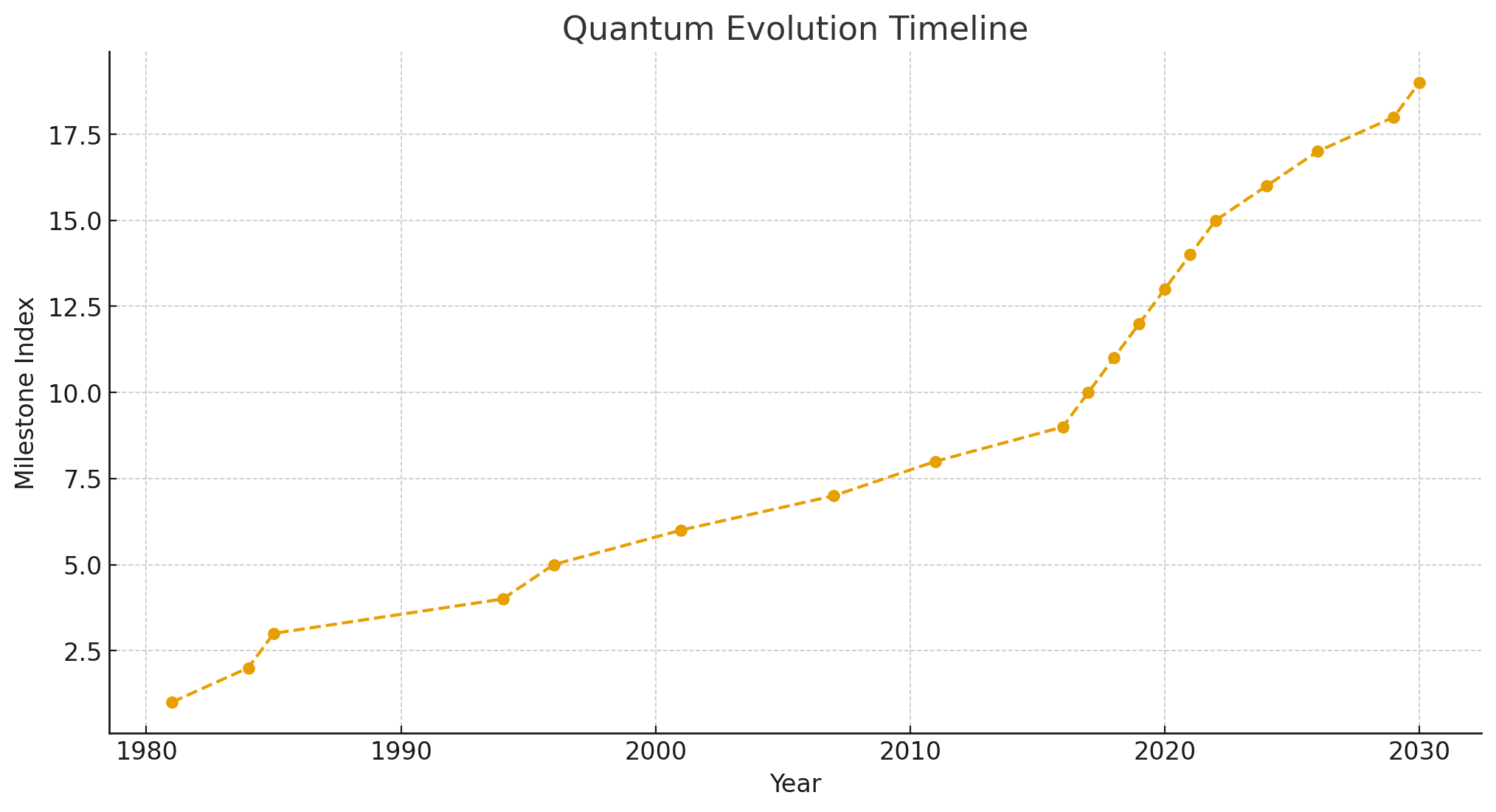
| 1981 |
Feynman (and Benioff) propose simulating quantum systems with quantum computers – laying conceptual groundwork for quantum computing. |
| 1984 |
Bennett & Brassard introduce the BB84 quantum key distribution protocol (first QKD scheme). |
| 1985 |
Deutsch describes the first universal quantum computer model (able to simulate any other QC). |
| 1994 |
Shor publishes his integer factoring algorithm, showing a QC could break RSA/DL cryptosystems in polynomial time. |
| 1996 |
Grover discovers his quantum search algorithm (quadratic speedup for unstructured search problems). |
| 2001 |
IBM/Stanford demonstrate Shor’s algorithm in the lab: factor 15 using a 7-qubit NMR quantum computer. |
| 2007 |
D‑Wave Systems demonstrates a 28‑qubit superconducting quantum annealing processor (early commercial QA device). |
| 2011 |
D‑Wave introduces its 128‑qubit “D‑Wave One” annealer, claimed as the first commercially available quantum computer. |
| 2016 |
China launches Micius, the first quantum-communications satellite (space-based QKD/teleportation demo). IBM releases the 5‑qubit IBM Q Experience (cloud QC access). NIST launches its Post-Quantum Cryptography (PQC) standardization process (call for algorithms). |
| 2017 |
Google (with NASA) reports quantum supremacy: 53‑qubit Sycamore solves a sampling problem in ~200s vs thousands of years classically. China’s Micius performs 1,200+ km ground-to-satellite quantum entanglement/teleportation. D‑Wave releases its 2,000‑qubit “2000Q” annealer to customers. |
| 2018 |
European Union launches the €1 billion, 10‑year Quantum Flagship initiative to fund quantum research and infrastructure. |
| 2019 |
Google/NASA achievement marks first widely reported quantum supremacy (as above); NIST announces Round 2 finalists in PQC competition (encryption/sig candidates including Kyber, Dilithium, SPHINCS+, Falcon). |
| 2020 |
Chinese USTC team (Pan’s group) builds Jiuzhang, a photonic quantum computer that samples in 200 s vs an estimated 2.5 billion years classically (quantum advantage). NIST selects Round 3 PQC finalists (e.g. CRYSTALS-Kyber, Dilithium, FALCON, SPHINCS+). |
| 2021 |
IBM unveils Eagle, a 127‑qubit superconducting processor (first >100 qubits in a single chip). NIST calls for additional PQC digital-signature algorithms to diversify its standardization. |
| 2022 |
NIST selects its first PQC standards: CRYSTALS-Kyber (encryption) and CRYSTALS-Dilithium, FALCON, SPHINCS+ (signatures). White House NSM-10 (May 2022) directs U.S. agencies to inventory crypto systems and prepare for a transition to quantum-resistant algorithms. OMB issues memo M‑23‑02 (Nov 2022) mandating agency PQC migration planning by 2030. |
| 2024 |
NIST publishes final PQC standards (FIPS 203–205) for the selected quantum-resistant algorithms. Major governments and industry scale up quantum networks and cryptographic implementations (e.g. TLS1.3+PQC pilot deployments). |
| 2025 (proj.) |
IBM aims for quantum advantage by end of 2026 (beyond classical performance) and a large-scale fault-tolerant QC by 2029. U.S. Executive Order (Jan 2025) renews focus on cyber innovation, highlights quantum threats, and requires agencies to adopt post-quantum cryptography (e.g. TLS 1.3 or newer by 2030). |